
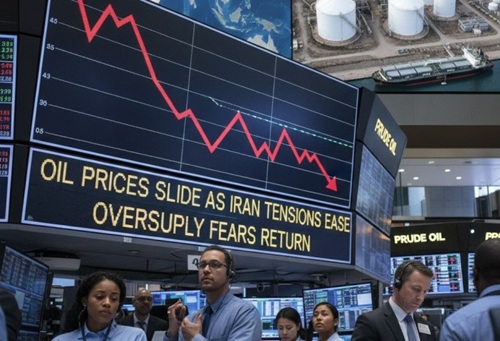
Oil prices fell sharply overnight as geopolitical concerns around Iran eased and investors refocused on the growing risk of excess supply in global energy markets. Brent crude dropped more than 4%, retreating to around the mid-US$60 per barrel range, wiping out most of the gains seen earlier in the week.
Earlier price strength had been driven by fears that escalating tensions between the United States and Iran could disrupt global oil supply. Iran is a significant oil producer and exporter, supplying millions of barrels per day, mainly to Asia. It also controls the Strait of Hormuz, a critical shipping route through which a substantial portion of the world's seaborne oil passes. Any threat to this route typically causes oil prices to spike.
However, sentiment shifted after US President Donald Trump's comments and Iran's foreign minister's conciliatory remarks suggested that immediate military action was unlikely. According to some media sources, diplomatic efforts by regional governments have also helped cool tensions in the Gulf, reducing the perceived risk of supply disruption.
As geopolitical risk faded, traders quickly turned their attention back to fundamentals — and the picture there looks less supportive for oil prices. Recent data from the US Energy Information Administration showed a larger-than-expected rise in US crude inventories, signalling weaker demand or excess supply. At the same time, markets are anticipating that Venezuelan oil exports could resume in the near term, adding further barrels to an already well-supplied market.
Energy analysts note that while geopolitical events can cause short-term volatility, oil prices are increasingly being capped by structural oversupply and slowing global demand growth. Even if tensions were to flare up again, prices may struggle to sustain rallies unless actual supply disruptions occur.
For Australian investors, falling oil prices can have mixed implications. Lower energy costs are generally positive for inflation and consumer spending, but they can pressure local energy producers and resource stocks in the short term. This environment reinforces the importance of selective stock picking and understanding how global macro trends influence different sectors of the ASX.
As markets continue to react quickly to headlines, investors should remain focused on fundamentals, risk management, and long-term strategy rather than short-term price swings.
Disclaimer: Ace Investors Pty Ltd (ABN 70 637 702 188), authorised representative of MF & CO. ASSET MANAGEMENT PTY LTD (AFSL No.520442). Ace Investors has made every effort to ensure the reliability and accuracy of the views and recommendations expressed in the reports published on its websites. Ace Investors' research is based on the information known to us or which was obtained from various sources, which we believe to be reliable and accurate to the best of our knowledge. Ace Investors provides only general financial information on its website, in reports, and through newsletters, without considering the economic needs or investment objectives of any individual user. We strongly advocate that you seek advice from your financial planner, advisor, or stockbroker on the merits of each recommendation before acting on any recommendation for your specific financial circumstances, and that you realise not all investments will be suitable for all subscribers. To the scope permitted by law, Ace Investors Pty Ltd excludes all liability for any loss or damage arising from the use of this website and any information published (including any indirect or consequential loss, any data loss or data corruption). If the law prohibits this exclusion, Ace Investors Pty Ltd hereby limits its liability to the scope permitted by law to resupply the services. The securities and financial products we study and share information on, in our reports, may have a product disclosure statement or other offer document associated with them. You should obtain copies of these before making any decision to acquire any security or product. You can refer to our Financial Services Guide.