
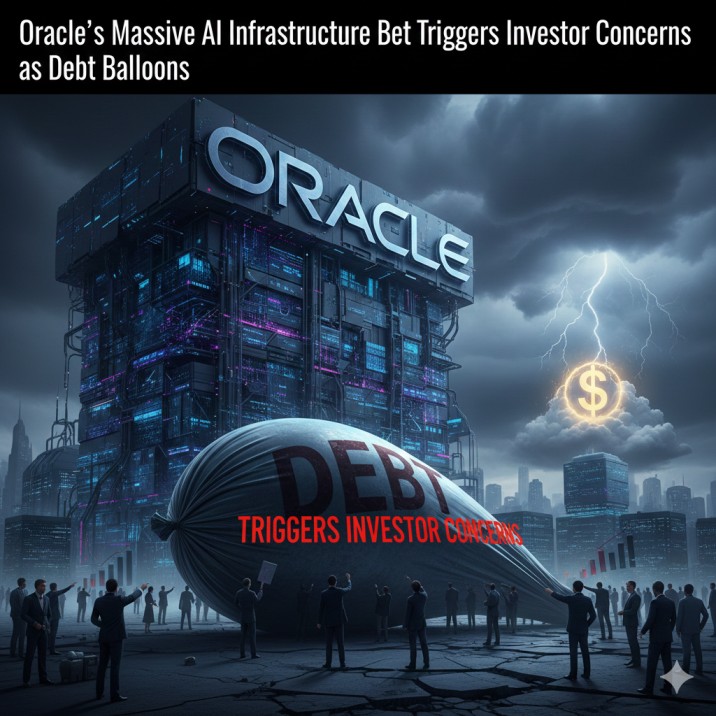
Oracle’s latest earnings update has rattled global markets after the US technology giant revealed a significant increase in spending to expand its AI-focused data-centre network. The announcement sent Oracle shares sharply lower as investors questioned the scale, timing and financial strategy behind the multibillion-dollar investment push.
The company reported quarterly revenue of US$16.1bn — a solid 14% lift year-on-year, but still short of market expectations. However, the bigger shock was Oracle lifting its capital expenditure guidance for the financial year to US$50bn, representing a more than 40% jump. Much of this spending is tied to accelerated construction of data centres designed to support AI developers such as OpenAI, Anthropic, Meta and Nvidia.
In the recent quarter alone, capex reached US$12bn, significantly above the expected US$8.4bn. The rapid expansion has pushed Oracle’s long-term debt to US$116bn, marking a steep 44% increase over the past year. Markets responded swiftly, with Oracle shares falling as much as 16% intraday before ending the session down almost 11%.
The aggressive bet reflects Oracle’s ambition to compete with cloud heavyweights Microsoft, Amazon and Google as demand for AI compute surges. Management insists the infrastructure build-out will quickly translate to higher revenue and margins over the medium term. The company expects full-year revenue to remain steady at US$67bn, followed by an additional US$4bn uplift in FY26.
Bookings continue to grow strongly — remaining performance obligations jumped 15% to US$523bn — supported by major AI-infrastructure contracts. But analysts warn that much of this revenue is back-loaded, while the required spending is upfront, creating a timing mismatch that puts cash flow under pressure.
Debt markets have also flagged concern. The cost of insuring Oracle’s bonds hit an all-time high, signalling rising perceptions of risk tied to its leveraged growth strategy. Forecasts from Morgan Stanley suggest the company’s net debt could approach US$290bn by 2028 if the current pace continues.
Oracle says it is working to reduce capital intensity by leasing capacity from third-party data centre operators and encouraging customers to procure their own AI chips. The company also highlighted strong demand beyond OpenAI should contracted capacity remain unused.
Despite short-term pressure, Oracle believes the strategic position it is building within global AI infrastructure will prove valuable over the coming decade. For investors, however, the key question remains whether revenue acceleration will ultimately justify the massive upfront investment.
Disclaimer: Ace Investors Pty Ltd (ABN 70 637 702 188), authorised representative of MF & CO. ASSET MANAGEMENT PTY LTD (AFSL No.520442). Ace Investors has made every effort to ensure the reliability and accuracy of the views and recommendations expressed in the reports published on its websites. Ace Investors' research is based on the information known to us or which was obtained from various sources, which we believe to be reliable and accurate to the best of our knowledge. Ace Investors provides only general financial information on its website, in reports, and through newsletters, without considering the economic needs or investment objectives of any individual user. We strongly advocate that you seek advice from your financial planner, advisor, or stockbroker on the merits of each recommendation before acting on any recommendation for your specific financial circumstances, and that you realise not all investments will be suitable for all subscribers. To the scope permitted by law, Ace Investors Pty Ltd excludes all liability for any loss or damage arising from the use of this website and any information published (including any indirect or consequential loss, any data loss or data corruption). If the law prohibits this exclusion, Ace Investors Pty Ltd hereby limits its liability to the scope permitted by law to resupply the services. The securities and financial products we study and share information on, in our reports, may have a product disclosure statement or other offer document associated with them. You should obtain copies of these before making any decision to acquire any security or product. You can refer to our Financial Services Guide.