
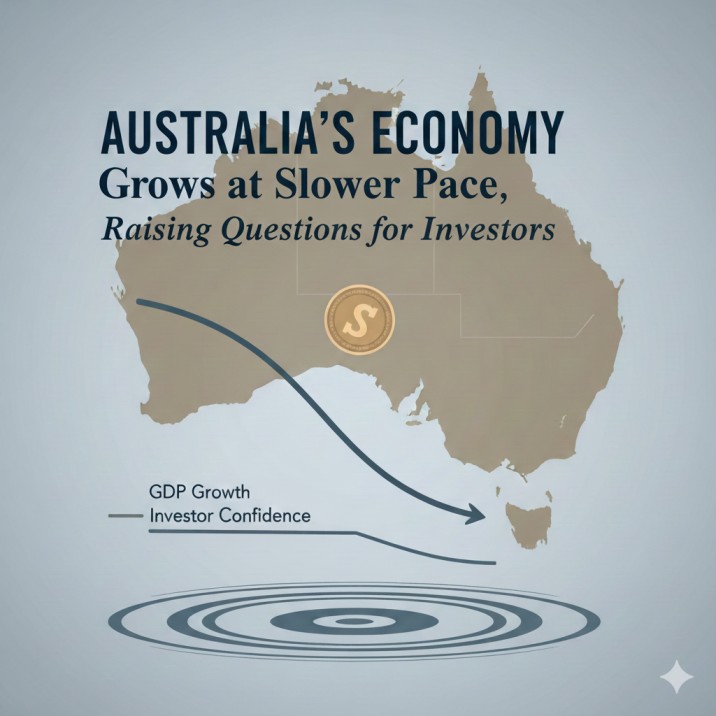
Australia's economy showed some resilience in the third quarter, but the numbers paint a cautious picture for those tracking growth trends. Gross domestic product expanded by 0.4 percent from the previous quarter, according to the latest figures released today. That's solid on the surface, but it fell short of economists' penciled-in forecast, coming in below the expected 0.5 percent bump. This softer-than-hoped performance has markets on edge, with the ASX 200 index dipping slightly by 0.28 percent in early trading as investors digest the implications.
What's behind the slowdown? Household spending held steady, up just 0.2 percent, as families continue to navigate higher living costs despite wage gains. Business investment picked up a bit, adding 0.6 percent, driven by construction and machinery upgrades, but exports took a hit from softer global demand, particularly in commodities headed to China. On the inflation front, underlying measures eased to 3.1 percent annually, which might buy the Reserve Bank some breathing room before any aggressive moves.
For investors, this GDP miss is a reminder to stay nimble. It strengthens the case for a potential pause in rate hikes next year, which could lift property and consumer stocks if borrowing costs ease. But it also flags risks in cyclical sectors like mining, where BHP and Rio Tinto shares edged lower today on export worries. Bond markets are already pricing in a modest RBA hike by mid-2026, pushing yields up five basis points. Meanwhile, pockets of strength emerged: 4D Medical's partnership with Philips for lung-imaging technology sent its stock soaring 12 percent, highlighting opportunities in medtech amid an aging population.
At Ace Investors, we see this as a pivot point. If quarterly growth stays subdued, expect more focus on defensive plays like utilities and healthcare, which returned 1.2 percent today. Diversify away from pure export reliance—consider ETFs tracking domestic services, projected to add 0.3 percent to GDP next quarter. Long-term, this underscores the need for balanced portfolios; a 0.4 percent clip isn't recession territory, but it's far from the boom times. Keep an eye on consumer confidence surveys released on Friday—they could tip the scales in favor of retail rebounds. Smart moves now can turn economic hiccups into buying chances.
Leadership Shake-Up at Jefferies Australia Signals Shifts in Deal-Making Landscape
The investment banking world down under is buzzing with change today, as Laura Golis, a key player in major deals, steps away from Macquarie to take the co-head role at Jefferies Australia. This marks the second significant departure from Jefferies in just two weeks, stirring talk about how it might reshape the competitive edge in mergers and acquisitions.
Golis brings a track record of steering high-stakes transactions, including tech buyouts and energy-sector consolidations totaling over $5 billion last year. Her move comes at a time when Australian M&A activity is heating up, with deal volumes up 15 percent year-to-date, fueled by private equity eyeing undervalued assets post-rate peaks. Jefferies, aiming to muscle in on bulge-bracket rivals, sees this as a coup to bolster its advisory bench.
But for investors, the ripple effects could be telling. Leadership transitions like this often lead to short-term uncertainty—expect a 2-3 percent wobble in banking stocks like those tied to Macquarie, which dipped 0.5 percent this morning. On the upside, fresh blood could accelerate cross-border deals, particularly in renewables, where Jefferies has been pitching aggressively. Broader market context: With GDP growth lagging, firms like these will hunt for efficiency plays, potentially sparking more IPOs in the small-cap space.
Ace Investors views this as a watchlist item for anyone in industrials or tech. If Jefferies ramps up under new leadership, it could unlock $10 billion in pent-up deals by mid-2026. Tip: Track advisory fees in quarterly reports—they're a leading indicator for sector health. While exits raise eyebrows, they also signal ambition in a market where adaptability wins. Stay tuned for Golis's first moves; they might just redefine who's calling the shots in Aussie finance.
AI Hype Cools Off: Time for Smarter Bets Beyond the Buzz
The shine is fading on artificial intelligence stocks, and fund managers are calling it as they see it. L1 Capital, a sharp-eyed player in global investments, says the air is leaking out of the AI bubble right now. As they scale up their funds, the team is pivoting to hunt bargains in overlooked corners of the market, from industrials to consumer goods.
Why the shift? AI valuations skyrocketed last year, with Nvidia-linked plays up 80 percent, but scaling costs and regulatory scrutiny are biting hard. L1 points to "deflation" in the sector—think slower adoption rates and earnings misses from overhyped startups. Australian tech indices, mirroring the Nasdaq, slipped 1.1 percent today, dragging names like WiseTech down 2 percent.
For everyday investors, this is less doom and more opportunity. The bubble talk doesn't mean AI's dead; it means picking winners gets tougher. L1's strategy? Broaden out— they've upped the stakes in value stocks yielding 4-5 percent, which could outperform if rates stabilize. In Australia, this echoes with ASX small-caps trading at 12 times earnings, a discount to the frothy U.S. peers.
Ace Investors agrees: Time to rebalance. Trim pure AI exposure if it's over 10% of your holdings, and eye hybrids like data centers that blend tech with infrastructure. Projections show AI contributing $200 billion to Aussie GDP by 2030, but only if grounded in reality. Our advice: Use this cooldown to build cash reserves for dips—volatility here could drop 15-20 percent in the short term. It's a natural cycle; smart friends know bubbles burst, but the real gains come from what's next.
Vulcan Energy's Massive Raise Fuels Green Push in Europe
Renewable energy got a hefty shot in the arm today, as Gina Rinehart-backed Vulcan Energy kicked off a $1.1 billion equity raise. This follows a whopping €2.1 billion ($3.7 billion) funding package for its Lionheart project in Germany, aimed at producing zero-carbon lithium for EV batteries.
Vulcan's play is all about geothermal tech to extract lithium without the water guzzling that plagues traditional mines. The raise, priced at a 10 percent discount to recent trades, will fast-track production to 25,000 tonnes annually by 2028—enough to power 500,000 electric cars. Rinehart's Hancock Prospecting, which holds a 10 percent stake, sees this as a hedge against dips in fossil fuel prices, aligning with Australia's critical minerals boom.
Investor angle: This injects firepower into the green sector, with Vulcan shares jumping 8 percent pre-raise. But dilution looms for current holders, potentially pressuring short-term prices. Broader wins? It bolsters supply chains for ASX peers like Pilbara Minerals, which is up 1.5 percent today, amid forecasts that EV demand will reach 20 million units globally next year.
At Ace Investors, we're optimistic—this aligns with the $15 billion in federal incentives for clean tech. For portfolios, allocate 5-7 percent to lithium plays; volatility's high, but returns could hit 25 percent annually through the decade. Watch European regs—they're the make-or-break. It's a bold bet on sustainability paying off, turning resource roots into future-proof gains.
Trump Family's Crypto Bet Crashes, Echoing Global Volatility
Crypto markets took a bruising today, with the Trump sons' American Bitcoin venture plunging almost 40 percent in a single session. The token shed $1.5 billion in market value, as trading volumes exploded to 40 times the daily norm—classic signs of panic selling amid broader turmoil.
Tied to U.S. political shifts and regulatory whispers, this drop wiped out post-election gains for the project, which launched with family endorsement to tap retail hype. Bitcoin itself rebounded 2 percent to $68,000, but altcoins like this one bore the brunt, highlighting the wild swings in speculative assets.
For Australian investors, the spillover is real: Local exchanges saw a 5 percent dip in BTC-AUD pairs, dragging ASX-listed crypto trusts down 3 percent. It's a caution on leverage—many Aussies hold 2-5 percent in digital assets, per recent surveys —but events like this underscore the need for diversification.
Ace Investors' take: Use dips to average in on established coins, but cap exposure at 3 percent. With global adoption rising—think ETFs pulling in $50 billion a year—this volatility is par for the course. Eye U.S. policy next week; more explicit rules could stabilize things. Remember, crypto's not going away, but neither is the rollercoaster—steady hands win here.
Disclaimer: Ace Investors Pty Ltd (ABN 70 637 702 188), authorized representative of MF & CO. ASSET MANAGEMENT PTY LTD (AFSL No.520442). Ace Investors has made every effort to ensure the reliability and accuracy of the views and recommendations expressed in the reports published on its websites. Ace Investors' research is based on the information known to us or which was obtained from various sources, which we believe to be reliable and accurate to the best of our knowledge. Ace Investors provides only general financial information on its website, in reports, and through newsletters, without considering the economic needs or investment objectives of any individual user. We strongly advocate that you seek advice from your financial planner, advisor, or stockbroker on the merits of each recommendation before acting on any recommendation for your specific financial circumstances, and that you realize not all investments will be suitable for all subscribers. To the scope permitted by law, Ace Investors Pty Ltd excludes all liability for any loss or damage arising from the use of this website and any information published (including any indirect or consequential loss, any data loss or data corruption). If the law prohibits this exclusion, Ace Investors Pty Ltd hereby limits its liability to the scope permitted by law to resupply the services. The securities and financial products we study and share information on, in our reports, may have a product disclosure statement or other offer document associated with them. You should obtain copies of these before making any decision to acquire any security or product. You can refer to our Financial Services Guide.