
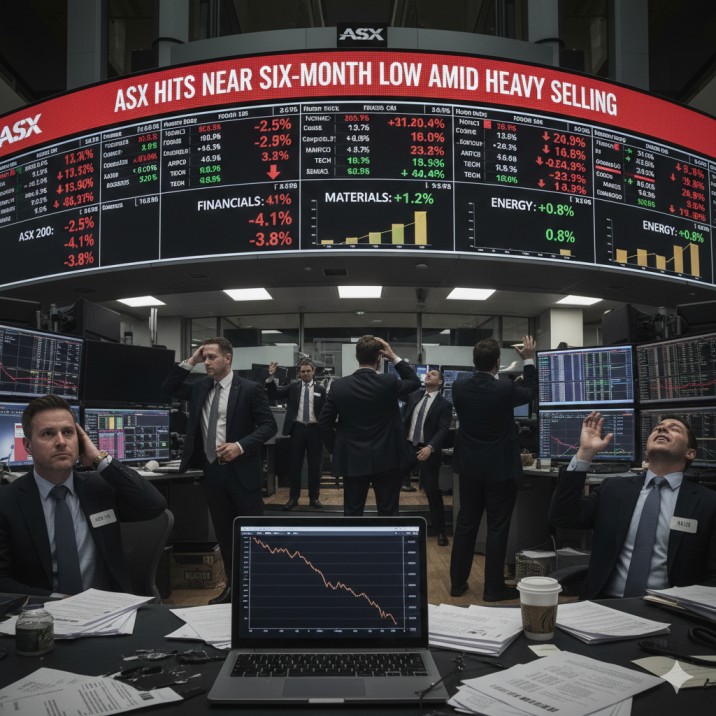
The Australian share market has been under pressure lately, with the S&P/ASX 200 approaching its lowest point in almost six months after a significant $60 billion wipeout over recent sessions. Investors are reacting to a mix of global cues and local developments, leading to sharp declines in certain areas while others hold up better.
Tech stocks have taken a big hit, continuing a tough run marked by extended losses driven by broader concerns about valuations and upcoming international earnings reports. Defence-related shares, such as DroneShield, saw significant declines following leadership changes and questions about product adaptability in fast-changing conflict zones. On the flip side, gold miners gained ground as precious metal prices firmed up, providing some support to the materials sector.
Other notable moves included travel companies making bids and adjustments, and agriculture firms reacting to results. Overall, the market's volatility reflects caution around interest rates staying higher for longer, both here and overseas. This kind of swing reminds investors to keep an eye on diversified positions rather than chasing momentum in overheated sectors.
For those tracking daily movements, these shifts highlight opportunities in defensive areas, such as resources, during uncertain times.
Challenges Mount for DroneShield as Battlefield Tech Faces Scrutiny
DroneShield, the ASX-listed counter-drone specialist, is facing growing headaches as its core products struggle to keep pace with rapid changes in modern warfare tactics and technology. Experts point out that evolving threats on the ground are testing the limits of the company's flagship systems, putting pressure on its share price.
The company has seen sharp declines recently, worsened by the resignation of its US boss and broader sell-offs in defence tech. While DroneShield built a strong reputation for innovative solutions in drone detection and neutralization, real-world adaptations in ongoing conflicts are proving more challenging than expected. This has raised questions about sustained growth in a sector that's seen huge hype.
Investors who jumped in during the peak are now reassessing, as the stock pulls back significantly from its highs. It's a classic case of high-growth tech facing operational realities. That said, the defence industry remains a key area for Australia, with geopolitical tensions supporting long-term demand if companies can innovate quickly.
Keeping tabs on how DroneShield responds could signal broader trends in Aussie defence exports.
Public Sector Pay Growth Outpaces Private, Adding to Inflation Worries
New data from the ABS shows wages in Australia's public sector are rising faster than in the private sector, even as overall growth stayed flat in September. This trend is fueling concerns at the Reserve Bank about persistent inflationary pressures, especially given that productivity is not keeping pace.
Higher labour costs in government jobs are contributing to broader price pressures, making it harder for the RBA to ease interest rates soon. It's a reminder that structural issues in the economy, such as sluggish productivity, can keep inflation stickier than expected. This directly affects borrowing costs for households and businesses, and hits rate-sensitive stocks in banking and real estate.
For investors, it underscores the need to monitor labour market dynamics closely. While a tight job market is good for workers, it complicates the path back to lower rates. Sectors like resources or exports might fare better in this environment compared to domestic consumer plays.
Staying informed on these macro shifts is key to navigating the current cycle.
Unions Push Back Against Using Super Funds for Financial Advice Bailouts
Trade unions are firmly opposing any moves to dip into Australia's massive $4.3 trillion superannuation pool to cover compensation for victims of poor financial advice. This stance could block potential government plans and protect retirement savings from being used as a safety net for industry failures.
The debate highlights ongoing tensions in the financial services sector, where past scandals have left many advisers and clients in limbo. Using super money would spread the cost across all workers, something unions argue is unfair and sets a bad precedent. It also raises questions about accountability in advice and how to fund fixes without hitting everyday savers.
For the average Australian, this is about safeguarding retirement nest eggs amid calls for reform. Investors in super-heavy funds or financial stocks should note how resolution plays out, as it could influence sector confidence and regulatory changes.
Protecting super integrity remains a priority, and this opposition strengthens that line.
Australia Faces Massive Housing Shortage – 1.9 Million More Homes Needed
To bring housing affordability back to reasonable levels, experts say Australia needs to build an extra 1.9 million homes right now – that's about 16% more than the current stock. This huge gap explains why prices remain out of reach for many, despite high interest rates.
The shortfall points to years of underbuilding, population growth, and supply constraints hitting the property market hard. It puts pressure on governments to ramp up construction, which could boost jobs in building and materials but also strain resources. For investors, this means potential upside in related ASX stocks, such as developers or suppliers, if policies deliver.
On the flip side, ongoing shortages support higher rents and values in the short term, benefiting landlords but hurting first-time buyers. Fixing this will take coordinated effort across planning, migration, and incentives.
It's one of the biggest economic challenges ahead, directly tied to household wealth and spending power.
Disclaimer: Ace Investors Pty Ltd (ABN 70 637 702 188), authorized representative of MF & CO. ASSET MANAGEMENT PTY LTD (AFSL No.520442). Ace Investors has made every effort to ensure the reliability and accuracy of the views and recommendations expressed in the reports published on its websites. Ace Investors' research is based on the information known to us or which was obtained from various sources, which we believe to be reliable and accurate to the best of our knowledge. Ace Investors provides only general financial information on its website, in reports, and through newsletters, without considering the economic needs or investment objectives of any individual user. We strongly advocate that you seek advice from your financial planner, advisor, or stockbroker on the merits of each recommendation before acting on any recommendation for your specific financial circumstances, and that you realize not all investments will be suitable for all subscribers. To the scope permitted by law, Ace Investors Pty Ltd excludes all liability for any loss or damage arising from the use of this website and any information published (including any indirect or consequential loss, any data loss or data corruption). If the law prohibits this exclusion, Ace Investors Pty Ltd hereby limits its liability to the scope permitted by law to resupply the services. The securities and financial products we study and share information on, in our reports, may have a product disclosure statement or other offer document associated with them. You should obtain copies of these before making any decision to acquire any security or product. You can refer to our Financial Services Guide.