

Australia’s external trade position remained in surplus in July, although the result showed some moderation in export activity and highlighted the uneven performance across key commodity sectors.
According to data from the Australian Bureau of Statistics (ABS), Australia recorded a A$1.92 billion trade surplus in July, exceeding market expectations of around A$1.50 billion. However, the surplus was lower than the A$2.34 billion recorded in June, as exports declined more sharply than imports.
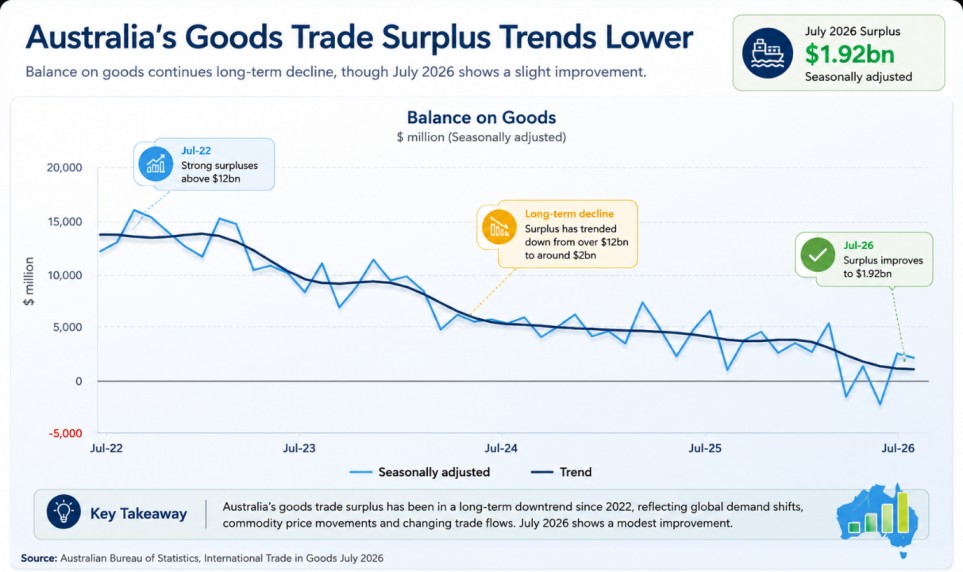
Balance on goods (Source: ABS)
Exports Come Under Pressure
Australian exports fell 3.3% month-on-month in July, reversing the strong 9.6% increase recorded in June. Total exports declined to approximately A$46.26 billion.
The biggest drag came from several major commodity categories. Non-monetary gold exports dropped 26.1%, while exports of coal, coke and briquettes declined 4.3%. Metal ores and minerals also recorded a 1.6% decline.
However, the export picture was not uniformly weak. Exports of other mineral fuels increased 9.6%, while LNG export volumes rose 8.5%. Rural exports also strengthened by 5.8%, supported by a significant increase in cereal grain shipments.
Imports Also Decline
Imports fell 2.5% in July to A$44.34 billion, following a marginal decline in June. The reduction was primarily driven by a 7.8% fall in intermediate and other merchandise goods and a 12.3% decline in fuel and lubricant imports.
These declines more than offset increases in capital and consumption-goods imports, helping Australia maintain its monthly trade surplus.
What It Means for Investors
The trade figures arrive alongside stronger-than-expected economic growth. Australia's economy expanded 0.4% quarter-on-quarter and 2.1% year-on-year in the second quarter, exceeding market forecasts.
The combination of resilient economic growth and relatively strong domestic activity has contributed to expectations that the Reserve Bank of Australia (RBA) could consider further monetary-policy tightening. Higher interest rates can influence household spending, business investment, property activity and equity-market valuations.
For Australian investors, the latest trade figures reinforce the importance of monitoring commodity prices, export volumes, global demand and the Australian dollar, particularly given the economy's exposure to resources and international trade.
Overall, July's figures point to a trade sector that remains in surplus but is experiencing shifting conditions across commodities and import categories. Investors will be watching upcoming economic data closely for further clues about Australia's growth trajectory and the RBA's next policy moves.
Disclaimer: Ace Investors Pty Ltd (ABN 70 637 702 188) authorized representative of MF & CO. ASSET MANAGEMENT PTY LTD (AFSL No.520442). Ace Investors has made all efforts to warrant the reliability and accuracy of the views and recommendations articulated in the reports published on its websites. Ace Investors research is based on the information known to us or which was obtained from various sources which we believed to be reliable and accurate to the best of its knowledge. Ace Investors provides only general financial information through its website, reports and newsletters without considering financial needs or investment objectives of any individual user. We strongly advocate that you seek advice, with your financial planner, advisor or stock broker, the merit of each recommendation before acting on any recommendation for their own specific financial circumstances and realize that not all investments will be suitable for all subscribers. To the scope permitted by law, Ace Investors Pty Ltd excludes all liability for any loss or damage arising from the use of this website and any information published (including any indirect or consequential loss, any data loss or data corruption). If the law prohibits this exclusion, Ace Investors Pty Ltd hereby limits its liability, to the scope permitted by law to resupply of the services. The securities and financial products we study and share information on, in our reports, may have a product disclosure statement or other offer document associated with them. You should obtain a copy of these before making any decision about acquiring any security or product. You can refer to our Financial Services Guide.