

Why Patience Can Be More Rewarding Than Trying to Time the Market
Investors naturally want to buy at the lowest price and sell at the highest. In practice, consistently predicting market peaks and troughs is extremely difficult. Unexpected economic data, interest-rate decisions, geopolitical events and changes in investor sentiment can move Australian shares quickly and without warning.
For long-term investors, patience may therefore be more effective than repeatedly trying to time short-term market movements.
Missing the Recovery Can Be Costly
Some of the market’s strongest sessions can occur shortly after periods of sharp weakness. Investors who sell during a downturn and wait for conditions to become completely certain may miss the early stages of a recovery.
Successful market timing requires two correct decisions: when to exit and when to reinvest. Even if an investor avoids part of a decline, returning too late could reduce the potential benefit.
Remaining invested in financially sound companies allows investors to participate when sentiment improves, although it does not protect against further short-term losses.
The ASX 200 Demonstrates the Value of Patience
The long-term movement of the S&P/ASX 200 provides a useful illustration of why patience can matter. As shown in the accompanying weekly chart, the index experienced several periods of volatility and sharp declines between 2010 and August 2026, including the significant market disruption in 2020. Despite these setbacks, the broader trend remained upward over the period.
The chart also highlights the difficulty of market timing. Investors who exited during periods of uncertainty may have avoided some short-term weakness, but they also faced the challenge of deciding when to reinvest. Remaining invested through market cycles can provide exposure to subsequent recoveries, although past performance does not guarantee future returns.
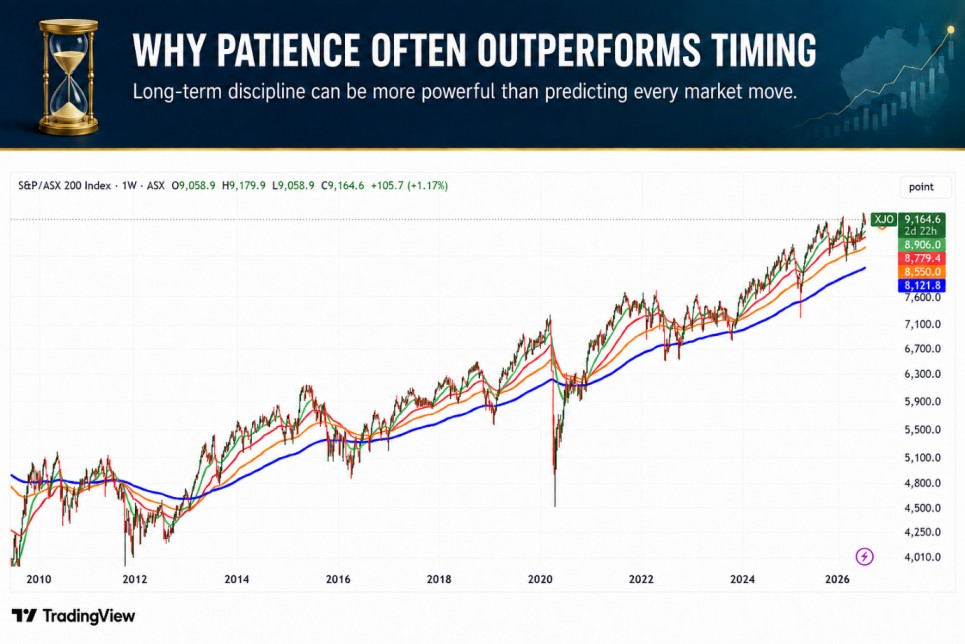
ASX 200 Index- Weekly Chart (Source: TradingView)
Compounding Needs Time
Patience allows investment returns to compound. When dividends are reinvested, investors purchase additional shares, which may generate further income over time.
Australian investors may also benefit from franking credits attached to eligible dividends. However, dividend payments and franking levels are not guaranteed and depend on company earnings, cash flow and capital-management decisions.
Compounding generally becomes more meaningful over longer periods. Constantly buying and selling can interrupt this process and may also create brokerage costs, tax consequences and emotionally driven decisions.
Focus on Businesses, Not Daily Price Movements
Short-term share prices can be influenced by headlines and market sentiment. Over longer periods, returns are more likely to reflect company fundamentals such as:
- Revenue and earnings growth
- Cash-flow generation
- Balance-sheet strength
- Competitive advantages
- Management’s capital allocation
- The price paid for the investment
Patience does not mean ignoring deteriorating fundamentals. Investors should continue reviewing company announcements, financial results, industry conditions and valuation. Selling may be appropriate when the original investment case is no longer valid.
Regular Investing Can Reduce Timing Pressure
Rather than waiting for the “perfect” entry point, investors may consider gradually investing at regular intervals. This approach spreads purchases across different market conditions and reduces dependence on a single entry price.
It cannot eliminate investment risk or guarantee a profit, but it may encourage greater consistency and discipline.
The Bottom Line
Market timing can appear attractive, but it depends on repeatedly making accurate decisions under uncertain conditions. Patient investing focuses instead on business quality, sensible valuations, diversification and sufficient time for an investment thesis to develop.
In investing, doing less—but doing it with discipline—can sometimes produce better outcomes than constantly reacting to market noise.
Disclaimer: Ace Investors Pty Ltd (ABN 70 637 702 188) authorized representative of MF & CO. ASSET MANAGEMENT PTY LTD (AFSL No.520442). Ace Investors has made all efforts to warrant the reliability and accuracy of the views and recommendations articulated in the reports published on its websites. Ace Investors research is based on the information known to us or which was obtained from various sources which we believed to be reliable and accurate to the best of its knowledge. Ace Investors provides only general financial information through its website, reports and newsletters without considering financial needs or investment objectives of any individual user. We strongly advocate that you seek advice, with your financial planner, advisor or stock broker, the merit of each recommendation before acting on any recommendation for their own specific financial circumstances and realize that not all investments will be suitable for all subscribers. To the scope permitted by law, Ace Investors Pty Ltd excludes all liability for any loss or damage arising from the use of this website and any information published (including any indirect or consequential loss, any data loss or data corruption). If the law prohibits this exclusion, Ace Investors Pty Ltd hereby limits its liability, to the scope permitted by law to resupply of the services. The securities and financial products we study and share information on, in our reports, may have a product disclosure statement or other offer document associated with them. You should obtain a copy of these before making any decision about acquiring any security or product. You can refer to our Financial Services Guide.