

Australia’s labour market showed clearer signs of cooling in July 2026, with unemployment rising and employment unexpectedly declining. The softer figures may reduce the immediate pressure on the Reserve Bank of Australia (RBA) to raise interest rates again at its September meeting.
According to the Australian Bureau of Statistics, the seasonally adjusted unemployment rate increased to 4.5% in July from 4.4% in June. This was above the market expectation of 4.4% and matched the highest unemployment rate recorded since November 2021.
Total employment fell by approximately 15,800 people to 14.81 million, compared with economists’ expectations for an increase. June’s employment gain was also revised upward to approximately 80,300.
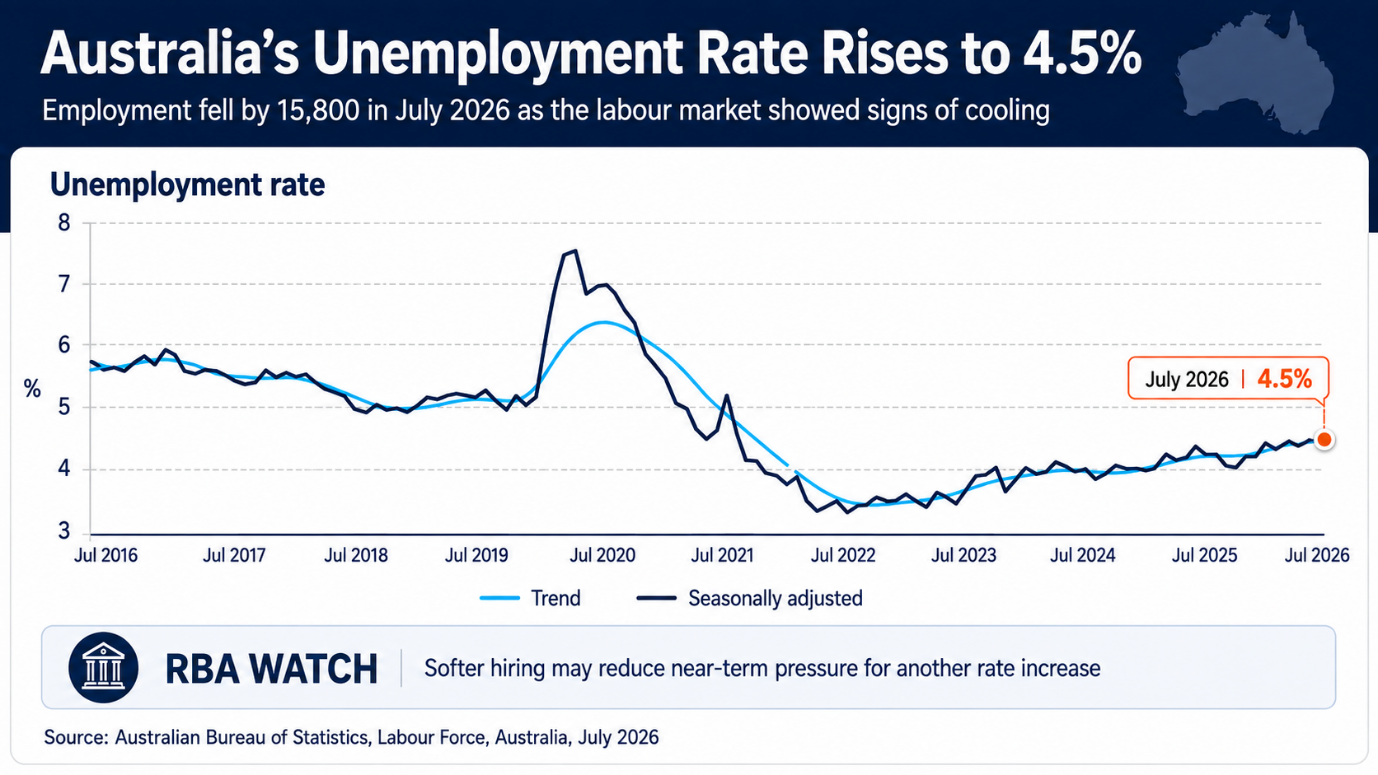
Unemployment rate (Source: Australian Bureau of Statistics—Labour Force, July 2026)
Despite the overall decline, full-time employment increased by approximately 16,300. However, this improvement was more than offset by a decline of around 32,200 in part-time employment. The participation rate edged down to 66.9% from 67.0%, while the employment-to-population ratio fell by 0.2 percentage points to 63.9%.
Other indicators also suggested that demand for labour was moderating. Total hours worked declined by 0.6% during July, while the underemployment rate remained at a two-year high of 6.4%. Nevertheless, employment was still approximately 191,900 higher than a year earlier.
Implications for RBA Interest-Rate Policy
The July figures add to evidence that Australia’s labour market is gradually becoming less tight. The 4.5% unemployment rate has already reached the level the RBA expected by the end of 2026.
A softer labour market could reduce wage and inflation pressures over time, strengthening the case for the RBA to leave the cash rate unchanged at its September meeting. The Australian dollar weakened modestly following the release as investors reduced expectations of an immediate rate increase.
However, one month’s data should be interpreted cautiously because monthly employment estimates can be volatile. Inflation remains above the RBA’s 2–3% target range, meaning further rate increases cannot be ruled out if upcoming inflation or wage data prove stronger than expected.
For Australian investors, the report may support interest-rate-sensitive areas such as real estate, consumer discretionary companies and growth stocks. Conversely, a sustained deterioration in employment could weaken household spending and create challenges for retailers, lenders and other consumer-facing businesses.
Overall, the July data support a cautious “wait-and-see” approach from the RBA, with upcoming inflation, wages and employment releases likely to determine the next policy move.
Disclaimer: Ace Investors Pty Ltd (ABN 70 637 702 188) authorized representative of MF & CO. ASSET MANAGEMENT PTY LTD (AFSL No.520442). Ace Investors has made all efforts to warrant the reliability and accuracy of the views and recommendations articulated in the reports published on its websites. Ace Investors research is based on the information known to us or which was obtained from various sources which we believed to be reliable and accurate to the best of its knowledge. Ace Investors provides only general financial information through its website, reports and newsletters without considering financial needs or investment objectives of any individual user. We strongly advocate that you seek advice, with your financial planner, advisor or stock broker, the merit of each recommendation before acting on any recommendation for their own specific financial circumstances and realize that not all investments will be suitable for all subscribers. To the scope permitted by law, Ace Investors Pty Ltd excludes all liability for any loss or damage arising from the use of this website and any information published (including any indirect or consequential loss, any data loss or data corruption). If the law prohibits this exclusion, Ace Investors Pty Ltd hereby limits its liability, to the scope permitted by law to resupply of the services. The securities and financial products we study and share information on, in our reports, may have a product disclosure statement or other offer document associated with them. You should obtain a copy of these before making any decision about acquiring any security or product. You can refer to our Financial Services Guide.