

The Japanese yen strengthened sharply against the US dollar after Japan and the United States confirmed a rare coordinated intervention in the foreign exchange market. The action followed a prolonged decline that had pushed the yen to nearly ¥164 per US dollar on 29 July 2026—its weakest level in around four decades.
Following confirmation of the intervention, the yen briefly strengthened to approximately ¥155.23 per US dollar before trading around the ¥156–¥157 range. At the time of writing, USD/JPY is trading at around ¥157.688 per US dollar on 4th August 2026. Japanese Finance Minister Satsuki Katayama confirmed that Japan purchased yen in coordination with US authorities and indicated that both countries were prepared to act again if excessive or disorderly currency movements continued.
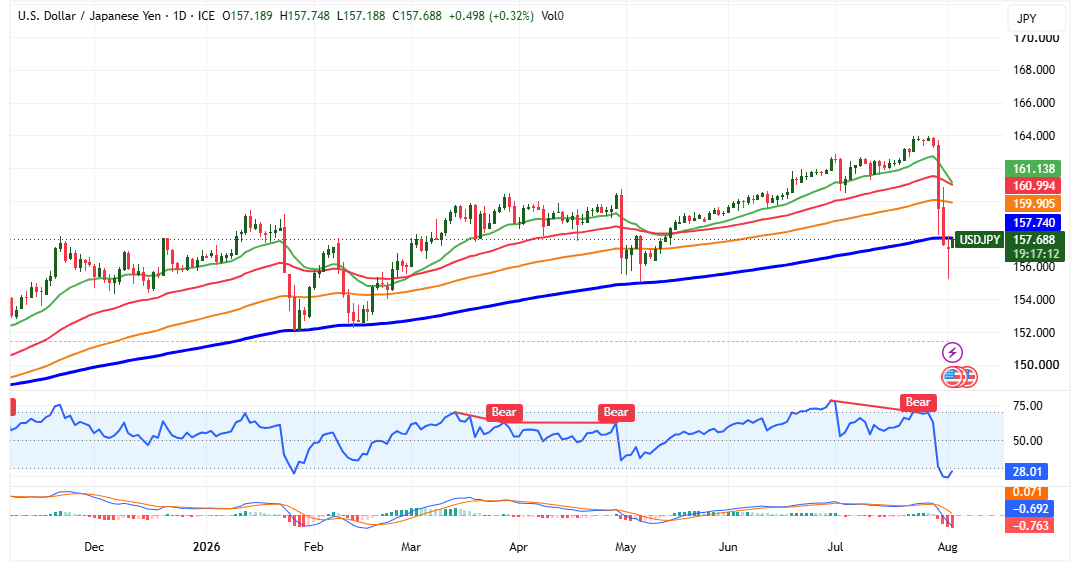
USD/JPY – Daily Chart (Source: TradingView)
The coordinated operation represents a significant policy development, given that Japan has generally intervened independently in recent decades. According to media reports, market estimates suggest Japan may have deployed approximately US$36.6 billion during the latest intervention. The United States also reportedly purchased yen by selling euros, allowing the action to remain focused on supporting the Japanese currency without directly signalling a broader policy of weakening the US dollar.
The intervention followed the Bank of Japan’s decision to maintain its benchmark interest rate at 1.0%. However, the central bank retained a relatively hawkish position amid concerns that elevated energy-import costs could sustain inflationary pressure.
Currency and equity markets were also influenced by a sharp decline in oil prices after US President Donald Trump postponed further military action against Iran, encouraging hopes of geopolitical de-escalation. Nevertheless, uncertainty remains elevated as Trump claimed negotiations were occurring, while Iran denied that direct talks with the United States were underway.
Implications for Australia
If the yen strengthens against the Australian dollar, Australian resources, agricultural products and tourism services could become relatively more affordable for Japanese customers, potentially supporting demand.
Australian companies generating earnings in Japan may also benefit from favourable currency translation. A stronger yen against the Australian dollar would allow the same yen-denominated earnings to convert into a higher Australian-dollar amount. However, the actual impact will depend on AUD/JPY movements and individual companies’ currency-hedging arrangements.
An unwinding of yen-funded carry trades could increase volatility across global equities, currencies and commodities. Meanwhile, sustained weakness in oil prices may help reduce Australian fuel costs and inflationary pressure, benefiting transport, aviation and consumer-facing businesses. Conversely, lower energy prices could weigh on ASX-listed oil and gas producers.
The sustainability of the yen’s recovery will depend on further intervention, Bank of Japan policy, US interest-rate expectations and Middle East developments. Australian investors should continue monitoring USD/JPY, AUD/JPY, oil prices and forthcoming US economic data.
Disclaimer: Ace Investors Pty Ltd (ABN 70 637 702 188) authorized representative of MF & CO. ASSET MANAGEMENT PTY LTD (AFSL No.520442). Ace Investors has made all efforts to warrant the reliability and accuracy of the views and recommendations articulated in the reports published on its websites. Ace Investors research is based on the information known to us or which was obtained from various sources which we believed to be reliable and accurate to the best of its knowledge. Ace Investors provides only general financial information through its website, reports and newsletters without considering financial needs or investment objectives of any individual user. We strongly advocate that you seek advice, with your financial planner, advisor or stock broker, the merit of each recommendation before acting on any recommendation for their own specific financial circumstances and realize that not all investments will be suitable for all subscribers. To the scope permitted by law, Ace Investors Pty Ltd excludes all liability for any loss or damage arising from the use of this website and any information published (including any indirect or consequential loss, any data loss or data corruption). If the law prohibits this exclusion, Ace Investors Pty Ltd hereby limits its liability, to the scope permitted by law to resupply of the services. The securities and financial products we study and share information on, in our reports, may have a product disclosure statement or other offer document associated with them. You should obtain a copy of these before making any decision about acquiring any security or product. You can refer to our Financial Services Guide.