

The Australian share market opened lower on Thursday after the U.S. Federal Reserve left interest rates unchanged but signalled that further policy tightening may still be possible later this year.
At its latest meeting, the Federal Reserve maintained the federal funds rate at 3.50%–3.75%, highlighting persistent inflation pressures despite solid economic growth and a resilient labour market. While policymakers opted to leave rates on hold, a growing number of Federal Open Market Committee members expect at least one additional rate increase before year-end.
The Fed's cautious stance weighed on investor sentiment globally, prompting a softer start for Australian equities.
At the time of writing, the S&P/ASX 200 Index is trading at 8,926.9, down 39.4 points (-0.44%).
From a technical perspective, the index remains above its key moving averages, suggesting the broader uptrend remains intact despite today's weakness. The 20-day moving average is positioned near 8,766, while the 50-day and 100-day moving averages are located around 8,749 and 8,742 respectively. Longer-term support remains near the 200-day moving average at 8,715.4.
Momentum indicators continue to show a constructive outlook. The Relative Strength Index (RSI) is holding above the neutral 50 level at 61.2, indicating positive momentum, while the MACD remains in bullish territory with the signal line continuing to trend higher.
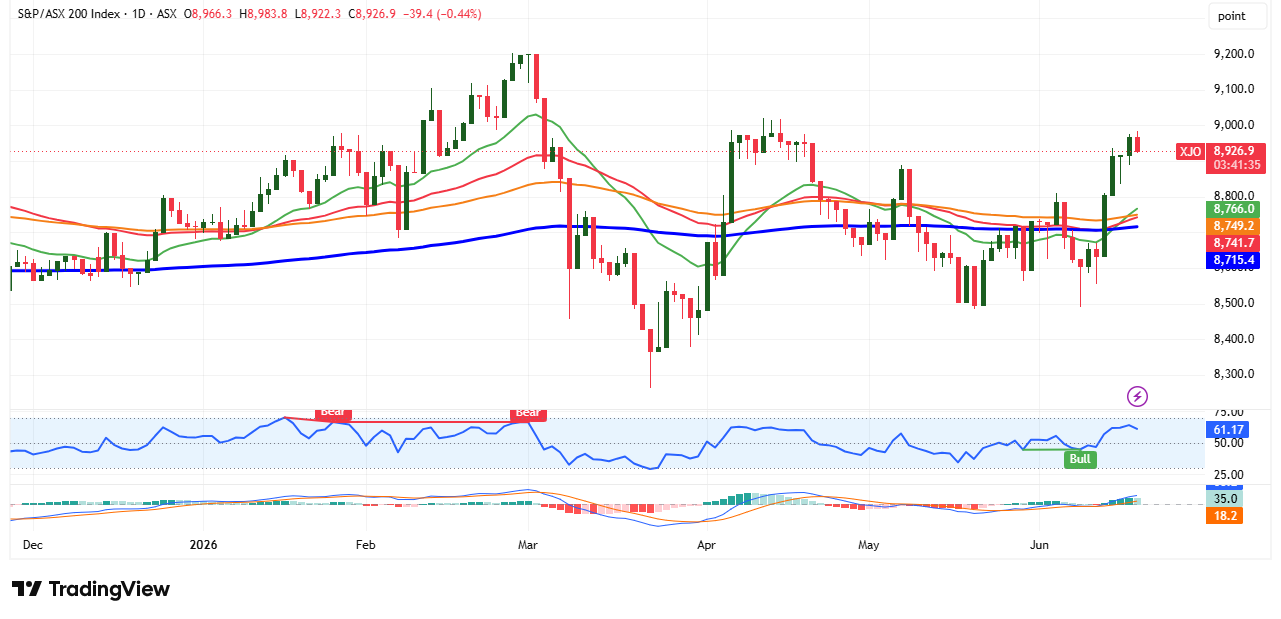
S&P/ASX200 Index (Source: TradingView)
According to the latest policy statement, the Federal Open Market Committee (FOMC) unanimously voted to maintain the current federal funds rate range while reaffirming its commitment to achieving price stability and supporting employment. The Fed noted that economic activity continues to expand at a healthy pace, supported by strong productivity growth, ongoing capital investment, and steady job creation.
However, inflation remains above the central bank’s long-term target of 2%. Policymakers highlighted that supply-side pressures, particularly higher energy costs linked to ongoing geopolitical tensions in the Middle East, continue to contribute to elevated price levels across parts of the economy.
A notable feature of this meeting was the leadership style of newly appointed Federal Reserve Chairman Kevin Warsh. In what many market observers view as a significant shift in communication strategy, Warsh announced several internal task forces aimed at reviewing key aspects of monetary policy. He also moved away from some traditional Fed practices, including providing detailed forward guidance on future rate movements.
The revised approach suggests the central bank may become less predictable in its communications, with policymakers preferring to assess incoming economic data before signalling future policy decisions. As a result, financial markets may experience increased volatility as investors attempt to interpret the Fed’s next move.
For Australia, developments in U.S. monetary policy remain highly relevant. The United States continues to influence global capital flows, bond yields, currency markets, and investor sentiment. A prolonged period of elevated U.S. interest rates could support the U.S. dollar while placing pressure on other currencies, including the Australian dollar.
The housing sector is also closely monitoring the Fed’s stance. Industry experts cited by international media sources suggest that mortgage rates may remain elevated if inflation persists and central banks maintain a restrictive policy environment. While the Federal Reserve does not directly set mortgage rates, its decisions influence broader financial conditions and long-term bond yields that ultimately affect borrowing costs.
For Australian investors, the latest Fed decision reinforces the importance of monitoring global inflation trends, central bank policy shifts, and their potential impact on equity markets, property markets, and investment portfolios. While rates were left unchanged this time, the Fed’s continued focus on inflation suggests that the path toward lower borrowing costs may be slower than many market participants had hoped.
Investors should remain disciplined, diversified, and focused on long-term opportunities as global monetary policy continues to evolve.
Disclaimer: Ace Investors Pty Ltd (ABN 70 637 702 188) authorized representative of MF & CO. ASSET MANAGEMENT PTY LTD (AFSL No.520442). Ace Investors has made all efforts to warrant the reliability and accuracy of the views and recommendations articulated in the reports published on its websites. Ace Investors research is based on the information known to us or which was obtained from various sources which we believed to be reliable and accurate to the best of its knowledge. Ace Investors provides only general financial information through its website, reports and newsletters without considering financial needs or investment objectives of any individual user. We strongly advocate that you seek advice, with your financial planner, advisor or stock broker, the merit of each recommendation before acting on any recommendation for their own specific financial circumstances and realize that not all investments will be suitable for all subscribers. To the scope permitted by law, Ace Investors Pty Ltd excludes all liability for any loss or damage arising from the use of this website and any information published (including any indirect or consequential loss, any data loss or data corruption). If the law prohibits this exclusion, Ace Investors Pty Ltd hereby limits its liability, to the scope permitted by law to resupply of the services. The securities and financial products we study and share information on, in our reports, may have a product disclosure statement or other offer document associated with them. You should obtain a copy of these before making any decision about acquiring any security or product. You can refer to our Financial Services Guide.