

Australia’s economy expanded at a slower-than-expected pace during the first quarter of 2026, reflecting the impact of persistent inflationary pressures, elevated fuel costs, and disruptions across key industries.
According to recent economic data released by the Australian Bureau of Statistics (ABS), Australia’s Gross Domestic Product (GDP) grew by 2.5% year-on-year during the March quarter, slightly below market expectations of 2.7%. On a quarterly basis, the economy expanded by 0.3%, also falling short of economists’ forecasts of 0.5%.
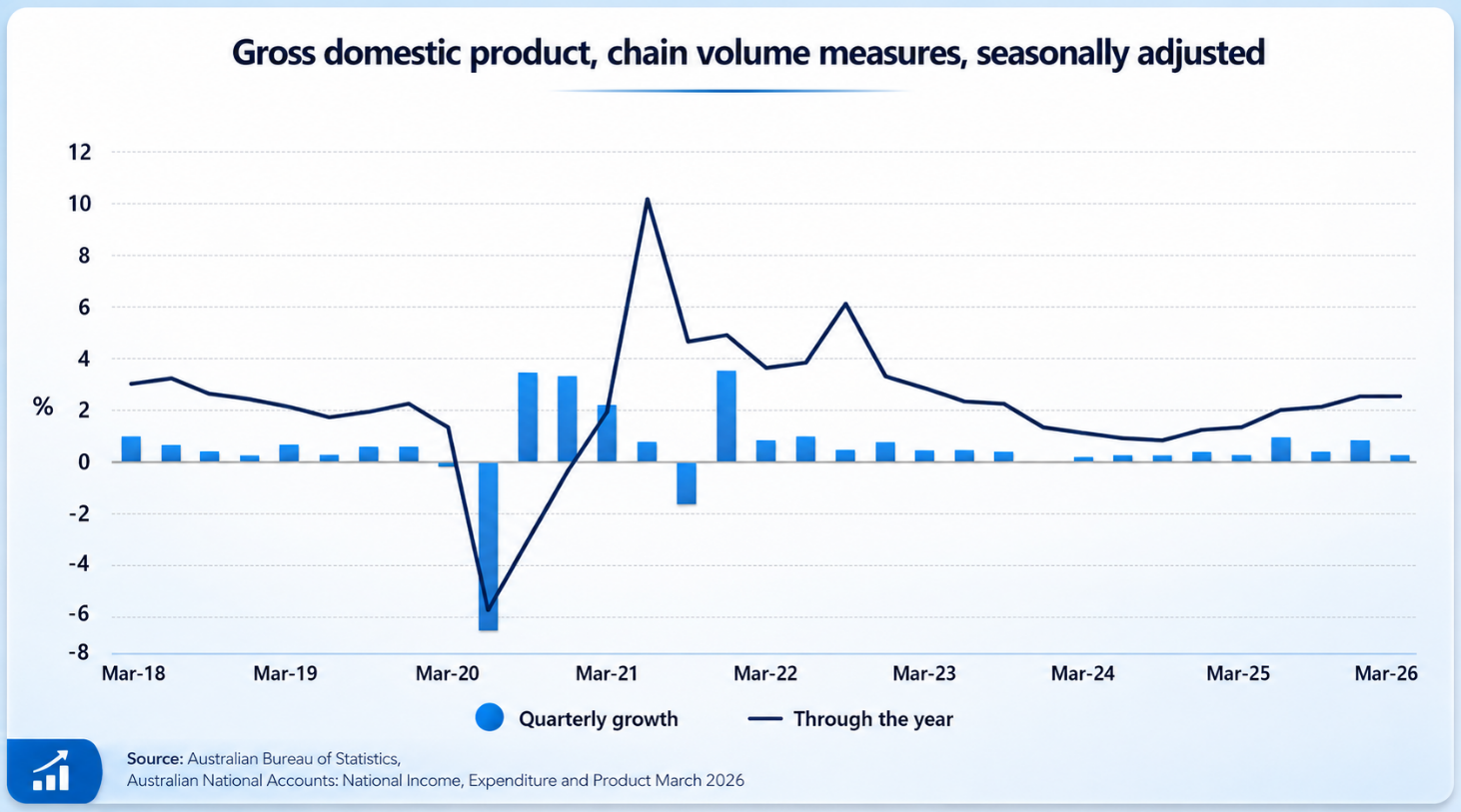
Gross domestic product, chain volume measures, seasonally adjusted (Source: ABS)
A major factor weighing on economic activity was subdued consumer spending. While household expenditure increased by 0.5% during the quarter, discretionary spending remained under pressure as Australians continued to grapple with higher living costs. Sticky inflation and rising fuel prices have reduced consumers’ purchasing power, prompting many households to prioritize essential spending over non-essential purchases.
Government expenditure also contributed less to economic growth compared to previous quarters. Reduced defence-related spending and the gradual withdrawal of electricity rebate programs lowered public-sector support for economic activity.
Australia’s export sector faced additional challenges during the quarter. Exports declined by 1.1%, largely due to softer international demand for commodities and operational disruptions in the mining industry. Adverse weather conditions, including the effects of Cyclone Narelle, impacted mining production and export volumes, highlighting the vulnerability of the sector to environmental disruptions.
A key contributor to economic growth was the services sector, including ongoing demand for engineering design and IT consultancy, and increased data centre operations. Gross Value Added (GVA) increased by 0.3%, with 14 out of 19 industries recording positive growth. Business services led the gains, supported by sustained demand for engineering design, information technology consulting, and expanding data centre operations.
The construction sector also provided support to economic activity, benefiting from increased residential building work, apartment developments, and data centre infrastructure projects. Meanwhile, manufacturing activity improved as agricultural demand boosted production of fertilisers and pesticides.
Despite these positives, the mining sector emerged as the largest drag on growth. Adverse weather conditions, including cyclone-related disruptions, negatively affected coal production and export activity. As a result, exports declined during the quarter, reducing the overall contribution of external trade to economic growth.
Consumer-facing industries faced ongoing challenges. Retail Trade, Accommodation and Food Services, and Arts and Recreation Services reported weaker activity as households remained cautious with discretionary spending. Elevated living costs, persistent inflation, and higher fuel prices continued to pressure consumer budgets.
Government expenditure also contributed less to growth compared to previous quarters. Lower defence spending and the conclusion of certain electricity rebate programs reduced public sector support for the economy.
Disclaimer: Ace Investors Pty Ltd (ABN 70 637 702 188) authorized representative of MF & CO. ASSET MANAGEMENT PTY LTD (AFSL No.520442). Ace Investors has made all efforts to warrant the reliability and accuracy of the views and recommendations articulated in the reports published on its websites. Ace Investors research is based on the information known to us or which was obtained from various sources which we believed to be reliable and accurate to the best of its knowledge. Ace Investors provides only general financial information through its website, reports and newsletters without considering financial needs or investment objectives of any individual user. We strongly advocate that you seek advice, with your financial planner, advisor or stock broker, the merit of each recommendation before acting on any recommendation for their own specific financial circumstances and realize that not all investments will be suitable for all subscribers. To the scope permitted by law, Ace Investors Pty Ltd excludes all liability for any loss or damage arising from the use of this website and any information published (including any indirect or consequential loss, any data loss or data corruption). If the law prohibits this exclusion, Ace Investors Pty Ltd hereby limits its liability, to the scope permitted by law to resupply of the services. The securities and financial products we study and share information on, in our reports, may have a product disclosure statement or other offer document associated with them. You should obtain a copy of these before making any decision about acquiring any security or product. You can refer to our Financial Services Guide.