

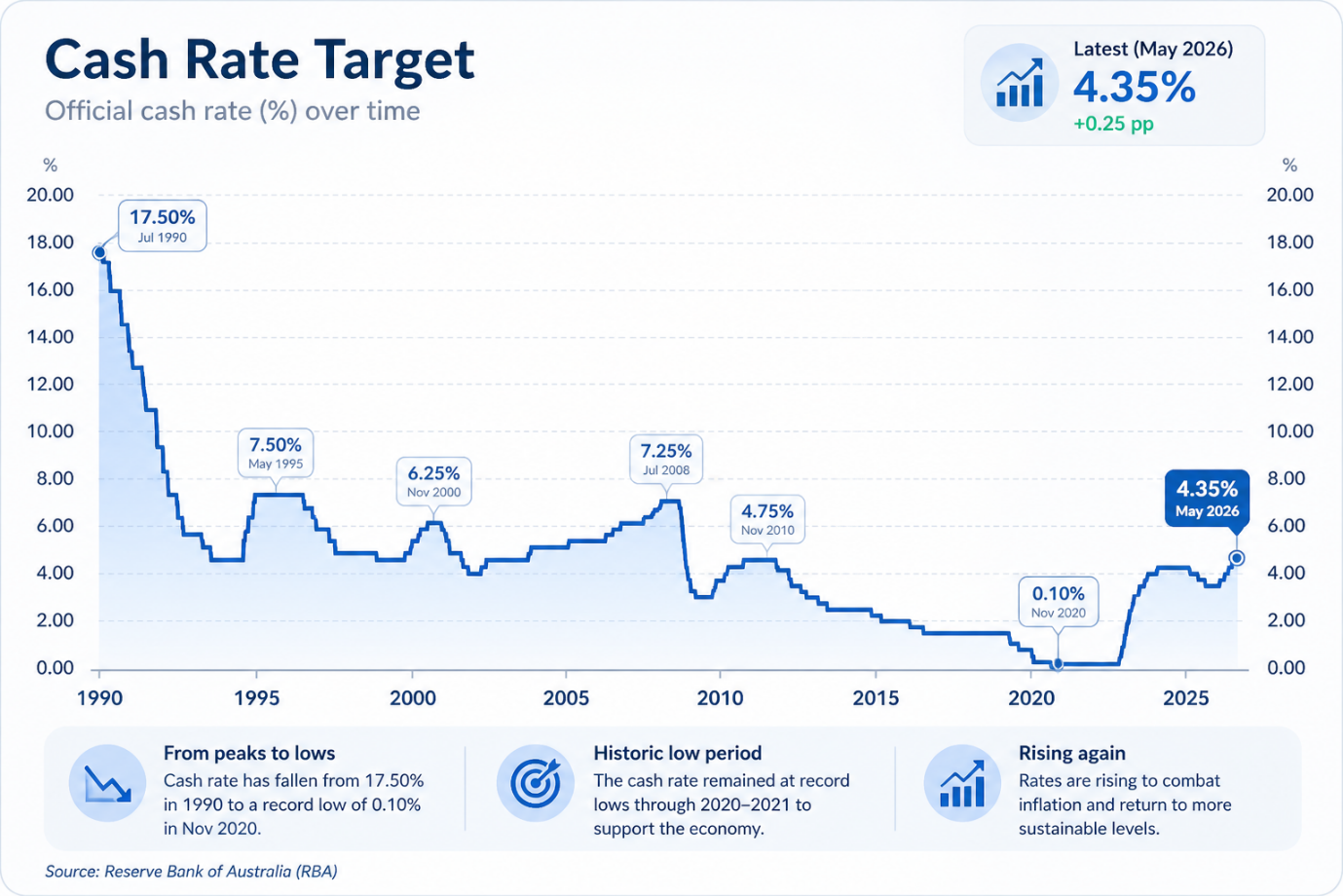
Australia’s central bank has once again stepped into tightening mode, raising its policy rate by 25 basis points to 4.35%. While the move was largely anticipated by markets, it reinforces a critical message: the fight against inflation is far from over.
Recent data shows inflation remains stubbornly elevated. Consumer prices rose around 4.6% year-on-year in March 2026, well above the central bank’s target band of 2–3%. Even more concerning is the persistence of core inflation, indicating that price pressures are broad-based rather than limited to volatile sectors.
Source: RBA
A key factor enabling the rate hike is the resilience of Australia’s labour market. Unemployment remains relatively low at 4.3%, while workforce participation continues to hold strong. This gives policymakers room to tighten financial conditions without immediately derailing economic activity. However, services inflation remains a major concern, as it tends to be sticky and slower to decline compared to goods prices.
The global environment is also adding complexity. Rising geopolitical tensions in the Middle East have disrupted energy markets, pushing oil and gas prices higher. This creates a fresh inflationary impulse through increased transportation, fuel, and production costs. As per some market observers, such external pressures could keep inflation elevated in the near term, even if domestic demand cools.
Market participants had already priced in a high probability of this rate increase, along with expectations of further tightening through 2026. Analysts suggest that the central bank is acting proactively to prevent second-round effects—where higher prices lead to rising wage demands and entrenched inflation expectations.
Central bank commentary highlights a deeper structural issue: supply constraints within the economy. With economic activity operating near capacity, policymakers aim to moderate demand to bring it in line with limited supply. At the same time, rising real wages could pose a risk if they further fuel inflation.
Another layer of complexity comes from fiscal policy. Government support measures aimed at households may unintentionally sustain demand, making the central bank’s job more challenging. While employment growth is expected to remain steady, higher interest rates are likely to weigh on household finances.
Looking ahead, inflation is projected to peak around mid-year, though uncertainty remains high due to geopolitical risks. Even if energy prices stabilise, their impact is expected to linger across the broader economy.
Overall, the central bank remains firmly focused on controlling inflation, even at the risk of slower growth. While recession risks are acknowledged—especially if global tensions persist—the policy stance will continue to evolve based on incoming data.
For investors, this signals a higher-for-longer interest rate environment, increased market volatility, and a continued need for disciplined portfolio strategies.
Disclaimer: Ace Investors Pty Ltd (ABN 70 637 702 188) authorized representative of MF & CO. ASSET MANAGEMENT PTY LTD (AFSL No.520442). Ace Investors has made all efforts to warrant the reliability and accuracy of the views and recommendations articulated in the reports published on its websites. Ace Investors research is based on the information known to us or which was obtained from various sources which we believe to be reliable and accurate to the best of its knowledge. Ace Investors provides only general financial information through its website, reports and newsletters without considering the financial needs or investment objectives of any individual user. We strongly advocate that you seek advice, from your financial planner, advisor or stock broker, on the merit of each recommendation before acting on any recommendation for their specific financial circumstances and realize that not all investments will be suitable for all subscribers. To the scope permitted by law, Ace Investors Pty Ltd excludes all liability for any loss or damage arising from the use of this website and any information published (including any indirect or consequential loss, any data loss or data corruption). If the law prohibits this exclusion, Ace Investors Pty Ltd hereby limits its liability, to the scope permitted by law to resupply the services. The securities and financial products we study and share information on, in our reports, may have a product disclosure statement or other offer document associated with them. You should obtain a copy of these before making any decision about acquiring any security or product. You can refer to our Financial Services Guide.