
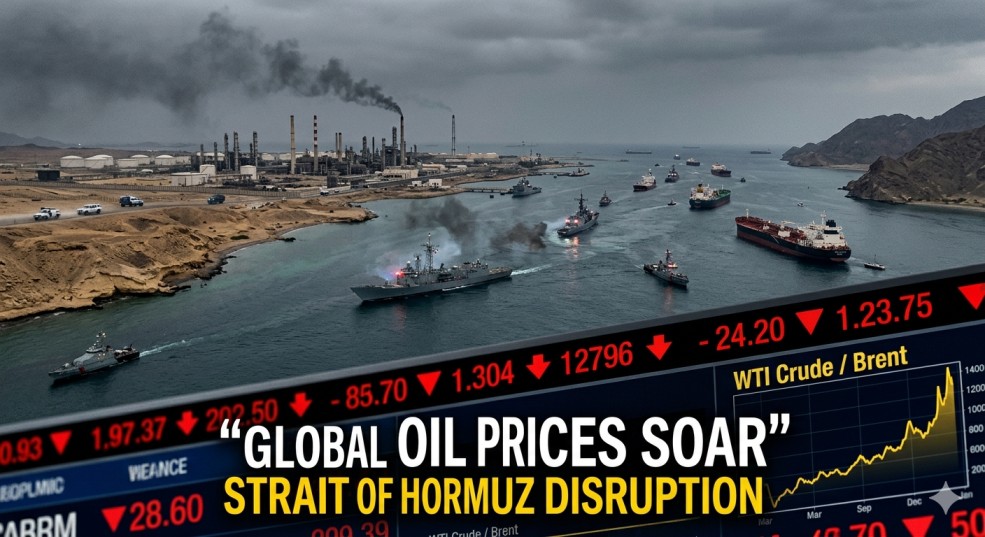
Global oil markets are facing renewed turbulence as supply disruptions in the Middle East drive a sharp spike in physical crude prices, raising concerns for energy-dependent economies, including Australia.
As per recent media sources, tight supply conditions have emerged after restricted movement of oil tankers through the Strait of Hormuz, a key global energy corridor responsible for nearly one-fifth of the world’s oil trade.
Physical Oil Prices Surge Above Benchmarks
Spot prices for North Sea crude have surged significantly, with immediate delivery barrels trading at steep premiums compared to futures contracts. This divergence highlights a critical imbalance between short-term supply availability and longer-term expectations.
Recently, on 7 April 2026, crude oil futures (NYMEX: CL1) was trading around $117.63 per barrel, before easing to approximately $98.56 per barrel as of 10 April 2026 at the time of writing. This sharp volatility reflects heightened uncertainty in global energy flows.
Market participants are scrambling to secure cargoes, especially in Europe and Asia, where dependence on Middle Eastern oil remains high. The sharp rise in prompt prices signals not just volatility, but a potential physical shortage of crude.
Supply Bottlenecks Driving Market Stress
Despite a temporary ceasefire between major geopolitical players, oil shipments through the Strait remain severely limited. Reports suggest that current flows are operating at a fraction of normal levels, creating logistical challenges and tightening global inventories.
Additionally, production setbacks in Saudi Arabia—triggered by infrastructure disruptions—have further strained supply. Combined, these factors are amplifying pressure on already fragile energy markets.
Why This Matters for Australia
For Australia, the implications are significant:
- Higher Fuel Costs: Rising crude prices could translate into increased petrol and diesel prices domestically.
- Inflationary Pressures: Energy costs are a key driver of inflation, potentially impacting interest rate outlooks.
- Market Volatility: Energy and resource stocks on the ASX may experience heightened volatility, presenting both risks and opportunities for investors.
ASX Energy Stocks to Watch
The current oil price environment could create both opportunities and risks across Australia’s energy sector:
- Woodside Energy Group Ltd (ASX: WDS) – A major LNG exporter that typically benefits from higher oil-linked pricing. It is currently trading at ~$33.280, with a market capitalisation of $63.36 billion and an annual dividend yield of ~4.95% (as of 10 April 2026).
- Santos Ltd (ASX: STO) – Strong exposure to global energy markets, with earnings leverage to oil price movements. It is currently trading at ~$7.900, with a market capitalisation of ~$25.81 billion and a dividend yield of ~4.37%.
- Beach Energy Ltd (ASX: BPT) – Mid-cap player that may see improved margins in a high-price environment. Currently, it is trading at ~$1.215 with a market capitalisation of ~$2.80 Bn and an annual dividend yield of ~5.69% as on 10 April 2026.
- Karoon Energy Ltd (ASX: KAR) – Higher-risk, higher-reward stock sensitive to crude price swings. Currently, it is trading at ~$1.990 with a market capitalisation of ~$1.40 Bn and an annual dividend yield of ~2.78% as on 10 April 2026.
While elevated oil prices generally support revenue growth for producers, sustained volatility and geopolitical uncertainty may also increase operational and market risks.
Futures vs Physical Market Disconnect
Interestingly, futures prices have remained relatively subdued compared to the surge in physical markets. Analysts suggest that futures markets are lagging behind real-time supply constraints, which could lead to further price adjustments if disruptions persist.
Outlook
Even if shipping routes reopen soon, normalization may take weeks due to logistical backlogs. Until then, global oil markets are expected to remain tight, with continued price volatility.
For investors, this evolving situation underscores the importance of closely tracking geopolitical developments and energy market trends.
Disclaimer: Ace Investors Pty Ltd (ABN 70 637 702 188) authorized representative of MF & Co. Asset Management Pty Ltd (AFSL No.520442). Ace Investors has made all efforts to warrant the reliability and accuracy of the views and recommendations articulated in the reports published on its websites. Ace Investors research is based on the information known to us or which was obtained from various sources which we believed to be reliable and accurate to the best of its knowledge. Ace Investors provides only general financial information through its website, reports and newsletters without considering financial needs or investment objectives of any individual user. We strongly advocate that you seek advice, with your financial planner, advisor or stock broker, the merit of each recommendation before acting on any recommendation for their own specific financial circumstances and realize that not all investments will be suitable for all subscribers. To the scope permitted by law, Ace Investors Pty Ltd excludes all liability for any loss or damage arising from the use of this website and any information published (including any indirect or consequential loss, any data loss or data corruption). If the law prohibits this exclusion, Ace Investors Pty Ltd hereby limits its liability, to the scope permitted by law to resupply of the services. The securities and financial products we study and share information on, in our reports, may have a product disclosure statement or other offer document associated with them. You should obtain a copy of these before making any decision about acquiring any security or product. You can refer to our Financial Services Guide.