
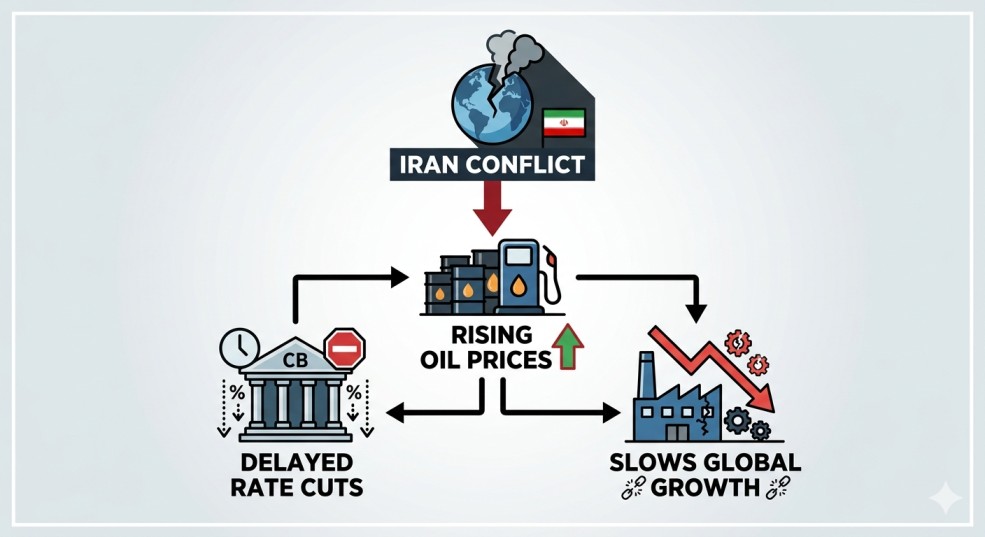
Escalating geopolitical tensions in the Middle East are pushing oil prices higher, raising concerns among economists about the potential impact on global economic growth and inflation. According to various media reports and economist surveys, a sustained surge in oil prices—triggered by the ongoing conflict involving Iran—could complicate monetary policy decisions and slow economic activity in several major economies.
Crude oil prices have climbed sharply in recent weeks, reportedly rising close to 50% following military strikes involving the United States and Israel against Iran. Prices are now hovering near US$95 per barrel. The increase has been driven largely by disruptions to oil supply routes, particularly the Strait of Hormuz, a strategic shipping channel through which roughly one-fifth of the world’s oil supply normally passes.
Iran’s response to the conflict has reportedly restricted movement through this vital corridor, tightening global supply and pushing energy prices higher. Energy analysts warn that prolonged disruption could further squeeze supply and elevate fuel costs globally.
Economists surveyed by academic research groups believe sustained oil prices near US$100 per barrel could have a noticeable impact on economic performance. Many estimate that such a scenario could reduce economic growth by 0.25 to 0.5 percentage points compared with a lower oil-price environment.
Higher energy costs are already filtering through to consumers and businesses. Rising petrol and diesel prices increase transportation and manufacturing costs, which can eventually lead to broader inflationary pressures. For central banks, this creates a challenging policy environment as they attempt to balance inflation control with economic growth.
In the United States, inflation remains above the Federal Reserve’s long-term target of 2%. Economists warn that persistently elevated oil prices could push inflation higher again, potentially delaying any plans to reduce interest rates. Market participants are increasingly expecting the Federal Reserve to maintain current interest rate levels for longer than previously anticipated.
Some analysts also believe that if energy prices remain elevated for an extended period, inflation could stay above target for several more years. Surveys suggest many economists now expect inflation to return to central bank targets only towards the latter part of the decade.
For global investors, the situation highlights how geopolitical events can quickly influence energy markets and monetary policy expectations. Energy-exporting economies could see short-term benefits from higher commodity prices, while oil-importing nations may face additional inflation pressures.
Australian investors should also closely monitor these developments. Higher oil prices can influence inflation trends, currency movements, and central bank policies worldwide, which in turn can impact global equity markets and commodity sectors.
If tensions in the region persist or supply disruptions intensify, energy markets are likely to remain volatile. Investors may need to prepare for continued uncertainty in both commodity prices and global interest rate expectations.
Disclaimer: Ace Investors Pty Ltd (ABN 70 637 702 188), authorised representative of MF & CO. ASSET MANAGEMENT PTY LTD (AFSL No.520442). Ace Investors has made every effort to ensure the reliability and accuracy of the views and recommendations expressed in the reports published on its websites. Ace Investors' research is based on the information known to us or which was obtained from various sources, which we believe to be reliable and accurate to the best of our knowledge. Ace Investors provides only general financial information on its website, in reports, and through newsletters, without considering the economic needs or investment objectives of any individual user. We strongly advocate that you seek advice from your financial planner, advisor, or stockbroker on the merits of each recommendation before acting on any recommendation for your specific financial circumstances, and that you realise not all investments will be suitable for all subscribers. To the scope permitted by law, Ace Investors Pty Ltd excludes all liability for any loss or damage arising from the use of this website and any information published (including any indirect or consequential loss, any data loss or data corruption). If the law prohibits this exclusion, Ace Investors Pty Ltd hereby limits its liability to the scope permitted by law to resupply the services. The securities and financial products we study and share information on, in our reports, may have a product disclosure statement or other offer document associated with them. You should obtain copies of these before making any decision to acquire any security or product. You can refer to our Financial Services Guide.