
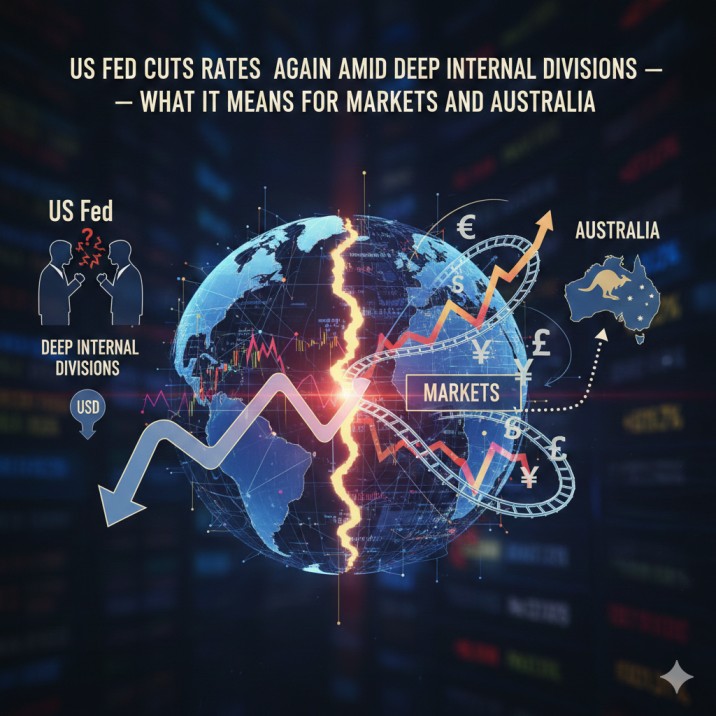
The US Federal Reserve has delivered its third consecutive interest rate cut, lowering the benchmark range to 3.50–3.75%, the lowest level in three years. While the move was widely expected, the meeting exposed unusually sharp divisions within the central bank over how to balance slowing employment growth with still-sticky inflation.
The Fed noted that labour conditions have weakened in recent months, with rising unemployment and softer hiring trends. At the same time, inflation — while moderating — is yet to convincingly settle near the central bank’s 2% target. This tension has created one of the most divided policy environments since 2019.
Largest Policy Revolt in Years
Three of the twelve voting members opposed the rate cut — the highest dissent in more than half a decade.
- Stephen Miran supported a larger 50-basis-point cut.
- Austan Goolsbee and Jeffrey Schmid favoured no change at all.
Beyond the official voters, several additional Fed officials indicated through the “dot plot” that they preferred keeping rates unchanged — suggesting even broader discontent inside the committee.
Powell Stresses Caution Ahead
Fed Chair Jerome Powell emphasised that further cuts will require clearer economic signals, noting rates are now close to “neutral”. According to the latest projections, Fed officials foresee only one additional cut in 2026, though forecasts vary widely — highlighting how uncertain the path ahead remains.
Critically, inflation is now expected to fall to 2.4% by the end of 2026, slightly better than prior estimates. However, concerns remain around sticky services inflation.
Markets Rally Despite Discord
Despite the unusual policy infighting, markets responded positively:
- The S&P 500 closed 0.7% higher.
- Two-year Treasury yields dropped to 3.54%
The Fed also announced it will resume short-term Treasury purchases to ease liquidity strains, after recently pausing its balance-sheet reduction program.
Political Pressure Mounts
President Donald Trump — a long-time critic of Powell — argued the Fed should have cut “at least double”. The White House is already evaluating candidates to replace Powell when his term expires in 2026, with Trump ally Kevin Hassett considered a leading contender.
What This Means for Australia
For Australian investors, the Fed’s shift has several implications:
- Equity markets may find further support as global liquidity improves.
- A softer USD could influence commodity prices, especially gold and industrial metals.
- The RBA will closely monitor the Fed’s stance, though Australia’s inflation profile differs significantly.
Overall, the Fed’s internal divide suggests policy uncertainty may remain elevated heading into 2026 — keeping market volatility alive.
Disclaimer: Ace Investors Pty Ltd (ABN 70 637 702 188), authorised representative of MF & CO. ASSET MANAGEMENT PTY LTD (AFSL No.520442). Ace Investors has made every effort to ensure the reliability and accuracy of the views and recommendations expressed in the reports published on its websites. Ace Investors' research is based on the information known to us or which was obtained from various sources, which we believe to be reliable and accurate to the best of our knowledge. Ace Investors provides only general financial information on its website, in reports, and through newsletters, without considering the economic needs or investment objectives of any individual user. We strongly advocate that you seek advice from your financial planner, advisor, or stockbroker on the merits of each recommendation before acting on any recommendation for your specific financial circumstances, and that you realise not all investments will be suitable for all subscribers. To the scope permitted by law, Ace Investors Pty Ltd excludes all liability for any loss or damage arising from the use of this website and any information published (including any indirect or consequential loss, any data loss or data corruption). If the law prohibits this exclusion, Ace Investors Pty Ltd hereby limits its liability to the scope permitted by law to resupply the services. The securities and financial products we study and share information on, in our reports, may have a product disclosure statement or other offer document associated with them. You should obtain copies of these before making any decision to acquire any security or product. You can refer to our Financial Services Guide.