
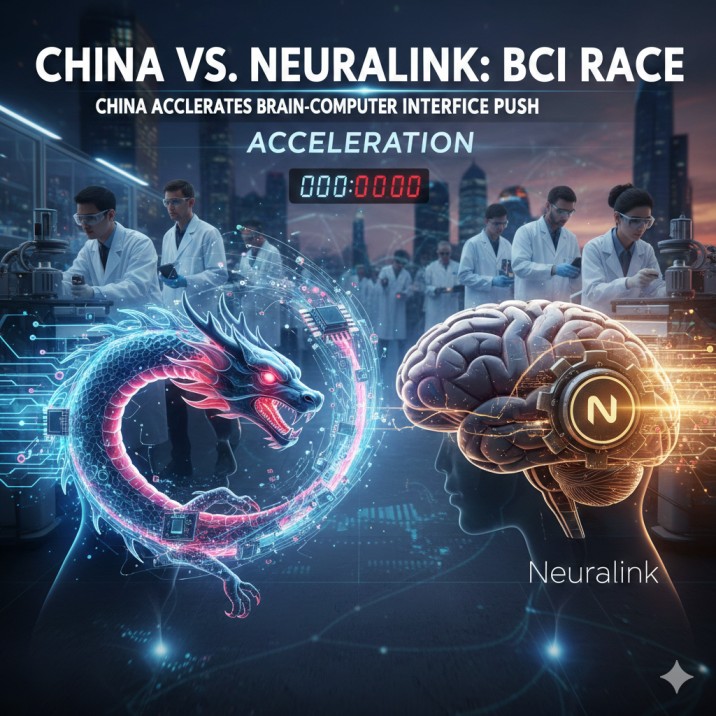
China is rapidly advancing its ambitions in brain-computer interface (BCI) technology, positioning domestic companies to compete with global players such as Neuralink Corp, founded by Elon Musk.
According to recent media reports, Beijing has formally designated BCI technology as a nationally strategic sector, setting a goal of cultivating 2 to 3 globally competitive companies by 2030. The policy direction includes streamlined regulatory approvals, increased clinical trial support, and expanded capital access — measures designed to fast-track innovation from laboratory research to patient application.
One Shanghai-based start-up, NeuroXess, has emerged as a notable contender. Founded in 2021, the company is already conducting human trials. In a recent development, a paralysed patient reportedly gained the ability to control a computer cursor within days of implantation. The pace of progress highlights how regulatory flexibility and investor enthusiasm are accelerating the commercialisation pathway.
China’s large patient base is also viewed as an advantage. With millions affected by severe motor impairment due to accidents or neurodegenerative diseases such as amyotrophic lateral sclerosis (ALS), clinical recruitment can proceed more efficiently than in many Western markets. Since early last year, multiple invasive brain-chip trials have reportedly been launched across the country.
Different Technical Approaches
While Neuralink’s system implants microscopic electrodes directly into brain tissue to capture signals, NeuroXess has opted for a surface-based approach. Its device uses a thin mesh placed on the brain's surface to collect neural signals without penetrating deep tissue, potentially reducing the risk of long-term scarring.
Neuralink has stated that its ultra-fine threads are designed to minimise tissue damage and improve signal stability. In early testing, the US company reported neural decoding speeds exceeding 10 bits per second, compared with lower levels disclosed by the Chinese start-up. Higher decoding speeds are critical for advanced applications such as converting thoughts into speech.
Beyond invasive implants, Chinese companies are also investing heavily in non-invasive BCI systems. These devices sit outside the skull and rely on technologies such as ultrasound, magnetic imaging, and AI-driven signal processing. Although historically less precise, advancements in artificial intelligence may significantly enhance their performance in the coming years.
Investment Momentum Builds
Funding momentum reflects growing investor confidence. Industry data indicates a marked increase in financing rounds for Chinese BCI start-ups during 2025, underscoring rising capital flows into the neurotechnology space.
For investors in Australia and globally, this development signals an intensifying global race in next-generation medical technology. BCIs hold transformative potential — from restoring mobility and communication in disabled patients to enabling new human-machine interaction models.
As regulatory frameworks evolve and clinical data expand, the sector could attract increasing institutional capital, strategic partnerships, and cross-border collaborations.
Disclaimer: Ace Investors Pty Ltd (ABN 70 637 702 188), authorised representative of MF & CO. ASSET MANAGEMENT PTY LTD (AFSL No.520442). Ace Investors has made every effort to ensure the reliability and accuracy of the views and recommendations expressed in the reports published on its websites. Ace Investors' research is based on the information known to us or which was obtained from various sources, which we believe to be reliable and accurate to the best of our knowledge. Ace Investors provides only general financial information on its website, in reports, and through newsletters, without considering the economic needs or investment objectives of any individual user. We strongly advocate that you seek advice from your financial planner, advisor, or stockbroker on the merits of each recommendation before acting on any recommendation for your specific financial circumstances, and that you realise not all investments will be suitable for all subscribers. To the scope permitted by law, Ace Investors Pty Ltd excludes all liability for any loss or damage arising from the use of this website and any information published (including any indirect or consequential loss, any data loss or data corruption). If the law prohibits this exclusion, Ace Investors Pty Ltd hereby limits its liability to the scope permitted by law to resupply the services. The securities and financial products we study and share information on, in our reports, may have a product disclosure statement or other offer document associated with them. You should obtain copies of these before making any decision to acquire any security or product. You can refer to our Financial Services Guide.