
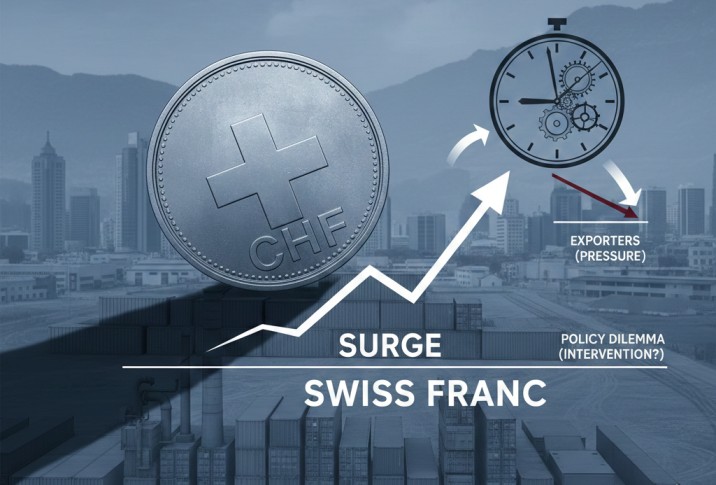
Switzerland’s export-driven economy is facing renewed strain as the Swiss franc extends its strong rally, intensifying pressure on major corporates and small manufacturers alike. As per multiple media reports, the currency has appreciated sharply against both the US dollar and the euro, reinforcing its reputation as a global safe-haven amid geopolitical uncertainty and ongoing trade tensions.
The franc has reportedly climbed around 3% so far this year, adding to double-digit gains recorded last year. The move has taken it to levels not seen since the sharp revaluation shock of 2015, when Switzerland unexpectedly removed its currency cap. For an economy where exports account for more than 70% of GDP, such currency strength has significant consequences.
Large multinationals, including pharmaceutical giant Roche and luxury watchmaker Swatch Group, have flagged currency headwinds, with management guiding for a notable drag on 2025 sales due to exchange rate movements. Luxury conglomerate Richemont, owner of Cartier, has also warned investors about the impact of a stronger domestic currency on overseas earnings.
The pain is particularly acute for small and medium-sized enterprises that earn revenues abroad but incur most of their costs in Switzerland. Trade bodies representing machinery, engineering, and metals industries have cautioned that prolonged currency strength could delay capital investment and erode industrial competitiveness over time.
Swiss equities have reflected these pressures. The benchmark Swiss Market Index has lagged broader European peers such as the Stoxx Europe 600 and the FTSE 100, continuing a pattern of relative underperformance seen last year. Analysts estimate that for every 1% appreciation in the franc, corporate profits for listed Swiss firms decline by nearly the same magnitude.
The currency’s rally presents a growing challenge for the Swiss National Bank. With its benchmark interest rate already at 0%, policymakers face limited room to manoeuvre. Cutting rates further would mean reintroducing negative interest rates — a policy the central bank has previously signalled reluctance to revisit. However, derivatives markets suggest investors see a meaningful probability of such a move if currency strength persists.
Compounding the issue, Swiss exporters have also had to contend with tariff uncertainty. While Switzerland and the United States have reached a framework agreement to limit additional US tariffs, the final legal implementation is still under negotiation.
For Australian investors, the Swiss situation highlights the broader theme of currency risk in globally exposed markets. Companies operating in small, open economies can face structural headwinds when domestic currencies strengthen sharply. Monitoring exchange rate dynamics, central bank policy signals, and sectoral exposure remains critical for global portfolio allocation decisions.
Disclaimer: Ace Investors Pty Ltd (ABN 70 637 702 188), authorised representative of MF & CO. ASSET MANAGEMENT PTY LTD (AFSL No.520442). Ace Investors has made every effort to ensure the reliability and accuracy of the views and recommendations expressed in the reports published on its websites. Ace Investors' research is based on the information known to us or which was obtained from various sources, which we believe to be reliable and accurate to the best of our knowledge. Ace Investors provides only general financial information on its website, in reports, and through newsletters, without considering the economic needs or investment objectives of any individual user. We strongly advocate that you seek advice from your financial planner, advisor, or stockbroker on the merits of each recommendation before acting on any recommendation for your specific financial circumstances, and that you realise not all investments will be suitable for all subscribers. To the scope permitted by law, Ace Investors Pty Ltd excludes all liability for any loss or damage arising from the use of this website and any information published (including any indirect or consequential loss, any data loss or data corruption). If the law prohibits this exclusion, Ace Investors Pty Ltd hereby limits its liability to the scope permitted by law to resupply the services. The securities and financial products we study and share information on, in our reports, may have a product disclosure statement or other offer document associated with them. You should obtain copies of these before making any decision to acquire any security or product. You can refer to our Financial Services Guide.